
Reclaim screens offer a smart, practical step for any screen printing operation, protecting your investment and helping you maintain consistent print quality from job to job. When you reclaim screens effectively, you extend screen printing equipment life by preserving mesh tension and frame integrity, reducing downtime, and cutting recurring costs. A good reclaim routine also supports reliable print alignment and color fidelity through consistent maintenance practices. Emulsion care remains a core part of the process, removing old emulsion and conditioning the mesh for new runs. By following these essentials, you minimize waste, protect mesh integrity, and keep plates and frames performing at their best in a busy production environment.
Viewed through the lens of broader print operations, reclaiming screens is really about the ongoing stewardship of your mesh and frames. The concept translates into mesh restoration—renewing the mesh, preserving tension, and ensuring the stencil can be reapplied accurately for future runs. In practical terms, this falls under a structured screen upkeep regime that complements general screen printing maintenance by reducing downtime and supporting consistent results. A modern reclamation workflow also encompasses thoughtful emulsion removal, edge cleanup, and preparation for new emulsions, so workflows stay efficient. Emphasizing these related practices can save money over time by extending the usable life of your equipment and supporting sustainable production.
Reclaim screens: Protect mesh and extend equipment life
Reclaim screens is a practical step for any shop aiming to protect mesh integrity and extend equipment life. By removing old emulsion and built-up ink, you restore the mesh surface and relieve stress points on the frame, helping to maintain proper tension and uniform printing across runs.
When you reclaim screens consistently, you reduce downtime, prevent recurring defects, and support a smoother workflow. This discipline is a core element of screen printing maintenance that keeps your entire production line efficient and cost-effective.
Step-by-step workflow for reclaim screens that preserves mesh and print clarity
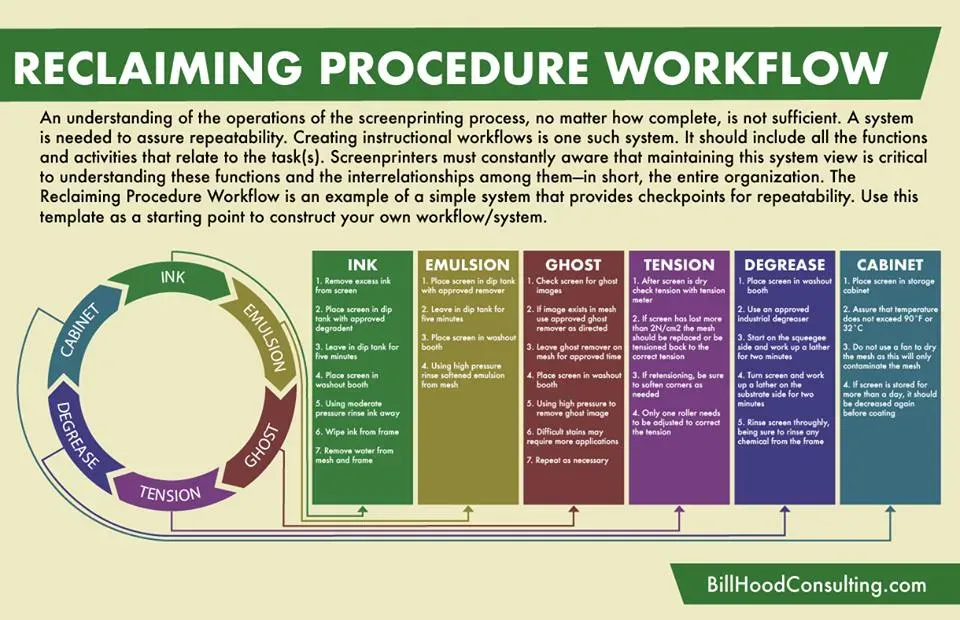
A clear, step-by-step workflow provides consistency and safeguards mesh health. Start with a dedicated reclaim space, gather the right tools, and wear PPE. A deliberate sequence helps optimize screen cleaning and emulsion care while avoiding damage to the mesh.
Detailed actions include removing ink, applying an emulsion remover, and gently scrubbing before a thorough rinse. Following product-specific dwell times and using cleaners compatible with your mesh protects fabric integrity and helps preserve stencil sharpness for future runs.
Emulsion care and storage strategies for longevity
Emulsion care is central to longevity. After reclaiming, inspect for emulsion remnants and re-emulsify only when you’re ready for the next run. Choose an emulsion remover that won’t degrade the mesh or frame and monitor the mesh surface for any lingering residues.
Storage and handling deeply influence emulsion life and overall mesh health. Store screens in a dry environment away from direct sun and heat, preferably vertically or flat with proper support, and label screens with reclaim dates to track wear and plan replacements.
Integrating screen printing maintenance into your routine
A robust screen printing maintenance routine includes regular screen cleaning after runs, plus periodic deep-cleaning and frame inspections. Regular care helps prevent ink and solvent buildup that can compromise emulsion adhesion and print consistency.
Maintain a clear maintenance log and dedicate a reclaim station to minimize cross-contamination with fresh emulsion work. A disciplined routine improves reliability, reduces defects, and supports consistent color matching and print registrations.
Common mistakes to avoid when reclaiming screens
Common pitfalls include over-reclaiming, which can damage mesh and shorten life, and using cleaners that are incompatible with your mesh or emulsion system. Skipping thorough drying also invites mold, odor, or print defects and should be avoided.
Other mistakes to sidestep are storing screens while still damp and neglecting regular inspection for tears, pulled threads, or pinholes. To prevent these issues, work with gentle pressure, verify cleaner compatibility, and ensure complete drying before storage.
Pro tips for extending equipment life and maximizing print quality
Pro tips start with building a practical maintenance calendar that includes monthly screen cleaning, quarterly deep cleaning, and annual frame inspection. Having a dedicated reclaim station with all necessary tools minimizes cross-contamination with fresh emulsion and speeds up the process.
Invest in a humidity- and temperature-controlled storage area to protect both screens and stored inks. Use mesh-specific brushes and non-abrasive pads, and maintain a reclaim log to track which screens were serviced and when. Following these practices helps extend the life of your equipment and sustain high durability, strong color fidelity, and productive uptime.
Frequently Asked Questions
What is reclaiming screens and how does it extend screen printing equipment life?
Reclaiming screens is the process of removing old emulsion and ink from the mesh, inspecting for damage, and preparing the screen for a fresh design. Proper reclaiming helps extend screen printing equipment life by preserving mesh tension, protecting the frame, and reducing downtime caused by print defects. It also supports ongoing screen cleaning and emulsion care for the next run.
How often should you reclaim screens as part of screen printing maintenance?
As part of screen printing maintenance, reclaim screens after runs when ink buildup or emulsion remnants begin to affect performance. Establish a regular schedule—such as monthly or per production batch—and document results to extend equipment life. Keeping a dedicated reclaim area helps maintain cleanliness and speed up the process.
What tools and best practices are used during reclaim screens to maintain emulsion care?
Use a soft-bristle brush, non-abrasive scrub pads, a compatible emulsion remover, and a careful rinse to minimize mesh damage. Follow the product dwell times, avoid harsh abrasion, and perform a post-cleaning inspection to support emulsion care and overall screen cleaning.
What are common mistakes during reclaim screens and how to avoid them to protect mesh?
Common mistakes include over-reclaiming, using incompatible cleaners, skipping drying, and storing damp screens. Avoid these by applying gentle pressure, choosing cleaners compatible with your mesh and emulsion, ensuring complete drying, and storing screens in a dry, protected area.
How does emulsion care fit into the reclaim screens process?
Emulsion care is central to reclaim screens: choose an emulsion remover that will not damage the mesh, remove old emulsion thoroughly, and re-emulsify only when you are ready for the next run. This supports stencil adhesion and maintains screen printing maintenance standards.
How should you store reclaimed screens to maximize longevity and extend equipment life?
Store reclaimed screens vertically in a dry, temperature-controlled space away from direct sun and chemicals. Label each screen with the last reclaim date and mesh type to track wear and plan replacements, helping to extend screen printing equipment life.
| Aspect | Key Points |
|---|---|
| Why reclaiming screens matters | – Protects investment in frames, mesh, and emulsion – Maintains consistent print quality – Extends the life of the screen printing workflow and reduces downtime – Essential for cost-effective, reliable production across runs. |
| Step-by-step process (overview) | 1) Preparation and safety: use gloves/eye protection; work in a ventilated area; dedicate a reclaim area; gather tools (soft-bristle brush, scraper/squeegee, non-abrasive pads, gentle degreaser, screen cleaner, pressure washer, drying rack). 2) Remove ink and old emulsion: scrape off ink; use mild cleaner to remove residual ink; for stubborn buildup, use a low-alkaline cleaner; safeguard mesh by prioritizing stencil area if needed. 3) Remove emulsion from the mesh: apply compatible emulsion remover; dwell 2–5 minutes; scrub softly; rinse thoroughly. 4) Inspect and repair: check for tears, pulled threads, and pinholes; decide to repair, re-stretch, or retire; professional re-stretching if tension is low. 5) Drying and curing: dry completely on a flat, non-humid surface; avoid direct sun and high heat. 6) Post-reclaim conditioning: light wipe-down; check compatibility with next emulsion; apply stencil adhesive or emulsion for next run. 7) Storage considerations: store vertically in a dry, unknown-temperature-controlled space; label reclaim date and mesh type. |
| What reclaiming does for your workflow | – Restores mesh to a clean, reusable state and ensures consistent emulsion adhesion for future runs – Minimizes meshing problems and pinholes; reduces costly reprints – Regular cleaning and emulsion care contribute to smoother registrations, sharper halftones, and more precise color matching. |
| Key practices to extend equipment life | – Regular screen cleaning after runs to prevent ink/solvent penetration – Gentle handling and drying to prevent warp and tension loss – Consistent maintenance schedules to catch issues early – Use cleaners compatible with mesh and emulsion – Proper storage and documentation to monitor lifespan and plan replacements. |
| Integrating emulsion care into your reclaim routine | – Emulsion care is critical; select an emulsion remover that won’t degrade mesh/frame/stencil – Inspect for emulsion remnants after reclaim and re-emulsify when ready for a new run – Keep emulsion away from stencil edges/corners to preserve mesh life and ensure smoother re-stenciling. |
| Common mistakes and how to avoid them | – Over-reclaiming: scrub too aggressively; use gentle pressure – Incompatible cleaners: use cleaners designed for your mesh – Skipping drying time: damp screens cause mold/defects – Storing while wet: increases warping/odor risk – Neglecting inspection: skip inspection leads to defects and downtime. |
| Pro tips for upkeep and longevity | – Create a maintenance calendar (monthly cleaning, quarterly deep clean, annual frame inspection) – Maintain a dedicated reclaim station to minimize cross-contamination – Invest in a moisture/temperature-controlled storage area – Use mesh-specific brushes and non-abrasive pads – Keep a reclaim log detailing screens reclaimed, dates, and findings. |
| Storage considerations for long-term life | – Store reclaimed screens vertically in a dry, unknown-temperature-controlled space to avoid warping – Keep frames away from direct sun and chemical exposure – Label screens with last reclaim date and mesh type to track wear over time. |