
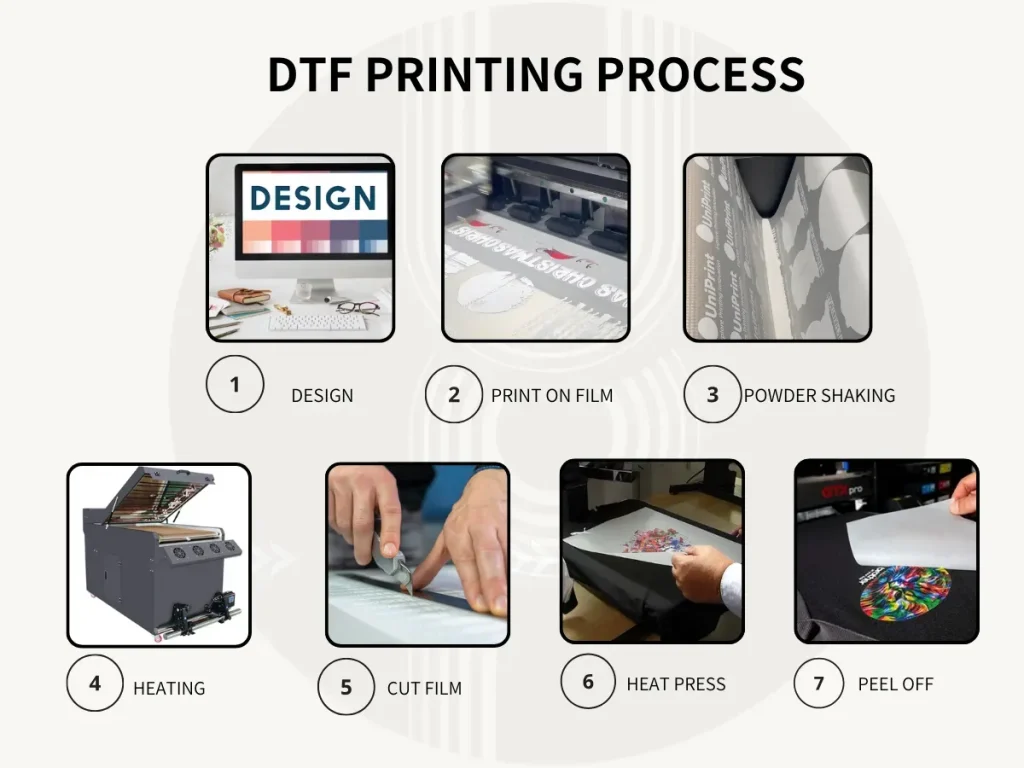
DTF Printing has emerged as a popular method for decorating garments, offering a versatile and durable alternative to traditional screen printing. Also known as direct-to-film transfers, this approach uses a PET film, textile inks, an adhesive powder, and heat to move designs onto a wide range of fabrics. If you’re exploring options to scale a printing business, customize apparel, or experiment with high-quality transfers, this DTF workflow offers a flexible path. This overview highlights the DTF ink types, curing considerations, and color management practices that influence durability and wash-fastness. From choosing films and substrates to refining color accuracy, you can deliver vibrant, long-lasting results suitable for diverse fabrics.
A film-to-fabric transfer method, sometimes called direct-to-film for garments, uses a PET carrier, adhesive powder, and heat to apply designs with precision. Compared with DTG, this film-based transfer approach relies on a printed carrier rather than ink deposited directly on fabric, fitting into a streamlined DTF workflow. Attention to DTF ink types and the DTF curing and color management steps ensures color accuracy and durable results across fabrics. Advances in film coatings and powder adhesion further support repeatable outcomes, making this approach a scalable option for on-demand garment decoration.
What is DTF Printing for Garments and Why It Matters
DTF Printing stands for Direct-to-Film and is a practical method for decorating garments. The process uses a PET film, textile inks, an adhesive powder, and a heat press to transfer designs onto a wide range of fabrics. This approach is valued for its versatility, vibrant color, and ability to work across different fabrics, making it a compelling option for scaling a printing business or customizing apparel.
Because DTF Printing relies on a film carrier, you gain strong opacity on dark fabrics and a consistent transfer that is less sensitive to pretreatment compared with some other methods. It also supports on-demand production and smaller run flexibility, helping brands test artwork or expand offerings without a large upfront investment. This makes DTF workflow approachable for both new entrants and established printers looking to diversify services.
DTF Workflow: From Design to Transfer
A typical DTF workflow includes several stages: design preparation, film printing, powder application, curing, and transfer. Each step contributes to color fidelity, durability, and wash-fastness, so documenting standard operating procedures matters.
Starting with design and color management, you align artwork with your printer and ink system. Use vector files for logos and clean rasters for photos, calibrate color profiles, and plan for white ink underbase on darker fabrics when needed. The workflow then proceeds to printing on the DTF film, powdering, curing, and finally transferring with heat and pressure, following manufacturer recommendations.
DTF Ink Types and Film: Choosing the Right Materials
DTF ink types are foundational to quality and durability. Most setups use white ink for opacity on dark garments, paired with translucent color inks to reproduce a broad gamut. Pigment-based textile inks are common for film transfer, and adhesive powders are tuned to the film’s coating to ensure reliable bonding.
Choosing the right film is equally important. Film translucency, surface texture, and coating affect image sharpness and color vibrancy when transferred. Match the film to your printer and ink family, and test combinations to ensure consistent results across batches.
DTF Curing and Color Management: Ensuring Durability
DTF curing and color management are central to durability and consistency. Proper curing solidifies the adhesive bond and minimizes edge lifting, while color management ensures your designs stay true across fabrics and runs. Both under-curing and over-curing can compromise adhesion and color fidelity.
Establish color profiles for different fabrics, run regular test prints, and consider a post-press cure to maximize wash resistance on heavier garments. Systematic calibration—along with routine printer maintenance and standardized workflows—helps deliver repeatable results you can trust for client orders.
DTF vs DTG: How to Decide Between Direct-to-Film and Direct-to-Garment
DTF vs DTG presents a trade-off between substrates, pretreatment, cost, and throughput. DTF transfers work on a broader range of fabrics, including blends and some performance materials, with reliable adhesion and simpler prep. DTG often performs best on 100% cotton and light fabrics, though pretreatment can add time and cost.
Consider your order profile when choosing between the two. For small runs and on-demand drops, DTF can be cost-effective and scalable, while DTG may offer advantages for certain fabrics and volumes—but both require careful maintenance and color management to optimize results.
Direct-to-Film for Garments: Selecting Substrates and Garments
Direct-to-film for garments is a flexible option that works on cotton, poly blends, and many synthetic fabrics. It enables vibrant designs with strong opacity on dark shirts and is widely used by brands seeking short-run customization and fast turnaround. The phrase direct-to-film for garments captures the core use case for this transfer method.
When selecting substrates, consider fabric color, weight, and dye consistency. Dark colors benefit from a white underbase, while lighter fabrics may reduce ink consumption and production time. Start with evenly dyed, pre-washed garments to minimize variation and test your design on the target fabric before scaling production.
Frequently Asked Questions
What is DTF Printing and how does it apply to direct-to-film for garments?
DTF Printing is a process that prints designs onto a PET film using textile inks, then applies adhesive powder, cures the film, and transfers the image to fabric with a heat press. This method is well-suited for direct-to-film for garments, offering vibrant color, strong opacity on dark fabrics, and a flexible workflow that works across cotton, blends, and some performance fabrics. The typical DTF workflow includes design prep, film printing, powdering, curing, and transfer. For best results, calibrate color profiles, select compatible ink types, and follow film and powder manufacturer guidelines.
DTF vs DTG: which method is better for different fabrics and production needs?
DTF printing vs DTG refers to two different garment decoration approaches. DTF printing supports a broader range of fabrics, often with less pretreatment and strong opacity on dark fabrics, making it suitable for small runs and on-demand orders. DTG shines on 100% cotton and light-colored fabrics but may require pretreatment and ongoing printer maintenance. Consider substrate, cost per unit, throughput, and durability when choosing between DTF printing and DTG.
What are the main DTF ink types and how do they affect print quality?
DTF ink types typically include white and color pigment inks designed for film transfer, plus adhesive powders in the film system. White ink provides opacity on dark fabrics, color inks deliver the design colors, and the adhesive powder ensures the transfer sticks to fabric after heat. Ink choice affects color gamut, wash durability, and compatibility with film and powders.
How does DTF curing and color management affect print results?
Curing is critical to fix the adhesive powder and set the ink on the film, influencing adhesion and durability after transfer. Proper curing also preserves color integrity. Pair curing with color management by calibrating profiles for your printer, ink set, and film, and by performing regular test prints to ensure consistent colors across batches.
What is the recommended DTF workflow from design to transfer?
A typical DTF workflow follows design preparation, film printing, powdering, curing, and transfer. Start with clean vector logos and calibrated color settings, print onto the DTF film with white underbase as needed, apply adhesive powder evenly, cure the film to fix the powder, and finally transfer the design with a heat press. Test and refine for your fabrics and equipment to ensure reliable results.
What factors influence color accuracy in DTF Printing and how can I manage them?
Color accuracy in DTF Printing depends on design color management, monitor-to-print translation, white underbase opacity, film translucency, and ink formulation (DTF ink types). Manage it by using standardized color profiles for your printer and film, calibrating displays, performing regular test prints, adjusting white ink density, and maintaining consistent curing conditions.
| Topic | Key Points |
|---|---|
| What is DTF Printing and why it matters | – Direct-to-film process uses a PET film, textile inks, adhesive powder, and a heat transfer to apply designs. – Produces vibrant colors, strong opacity on dark fabrics, and works with a wide range of materials. – Balances quality, cost, and ease of use, making it attractive for small runs and on-demand production. |
| Core workflow | – Design preparation, film printing, powder application, curing, and transfer. – Each step affects final look, durability, and wash-fastness. |
| Design and color management | – Use vector files for logos and clean rasters for photos. – Calibrate color profiles to printer/ink/film. – White ink often serves as the base for opacity on dark fabrics; plan underprints as needed. – Arrange elements for proper spacing and edge-to-edge or spot designs. – Consistency reduces color variance across batches. |
| Printing on DTF film | – Involves textile inks designed for fabric durability; typically uses a white underbase followed by color layers. – Film choice matters for translucency, texture, and adhesion. |
| Powdering and curing | – Adhesive powder bonds printed areas and forms a transfer-ready matrix. – Curing melts the adhesive; under- or over-curing can affect adhesion and color integrity. |
| Transfer to fabric | – Heat press applies the design with controlled temperature, time, and pressure. – Typical 12–20 seconds; hot-peel vs cold-peel workflows. – Follow manufacturer recommendations and refine for materials. |
| Ink types and materials | – Pigment-based textile inks are common; white ink provides opacity on dark garments. – Color inks should cover a wide gamut with good wash durability. – Adhesive powders affect bonding; curing behavior varies by powder. – Film compatibility matters for surface texture, translucency, and coating. |
| DTF vs DTG: key differences to know | – Substrates: DTF works on a broader range of fabrics; DTG favors 100% cotton/light fabrics. – Setup/maintenance: DTF often simpler for certain fabrics; DTG requires pretreatment and ongoing maintenance. – Cost and throughput: DTF is cost-effective for small runs and on-demand; DTG may be favorable for large volumes in some cases. – Durability and feel: DTF transfers typically have a soft hand and strong wash durability on dark fabrics. |
| Design and garment selection tips | – Fabrics: cotton, cotton blends, and poly-cotton blends; some synthetics may need adjustments. – Fabric color: white underbase for dark fabrics; lighter fabrics may require less white. – Garment quality: pre-washed, evenly dyed yields better results. – Design considerations: high-contrast designs with clean edges; avoid very small text. |
| Color management and finishing touches | – Calibrate workflow for consistent color reproduction across runs. – Some operators apply a post-press cure for durability. – Create standard color profiles for fabrics and finishes. |
| Common pitfalls and troubleshooting | – White underbase not fully opaque: adjust white ink density or formulations. – Powder clumps or weak bonding: check powder system, film temperature, and curing duration. – Bleeding on fabrics: test fabric compatibility and adjust inks, prep, and heat settings. – Durability issues after wash: revisit cure times and adhesive quality; run test washes. |
| Maintenance, costs, and scaling | – Regular printer cleaning, nozzle checks, film handling, and powder maintenance are essential. – Costs include printer depreciation, ink/film, and heat-press operations. – For scaling, implement consistent workflows, standardized color profiles, and in-house testing to minimize reprints and returns. |
Summary
Concisely, the table above summarizes the key points about DTF Printing and how it works, including workflow steps, materials, comparisons with DTG, design considerations, and troubleshooting.
Conclusion: DTF Printing offers a compelling pathway for garment decoration, combining vivid color reproduction, broad fabric compatibility, and a streamlined workflow suited to on-demand production. By mastering the core steps—from design and film printing to powder curing and heat transfer—and selecting appropriate inks, adhesives, and films, you can achieve durable, high-quality transfers. DTF Printing enables brands and print shops to run small batches cost-effectively, customize apparel, and experiment with diverse fabrics, while maintaining wash-fastness and color accuracy. When compared with DTG, DTF provides broader substrate compatibility and often simpler setup for dark garments. Building a repeatable, color-accurate workflow will help you scale a successful DTF Printing operation and deliver standout garments that endure washing and wear.